
Moving Beyond Participation: Ethical Youth Engagement in Permanency Practice
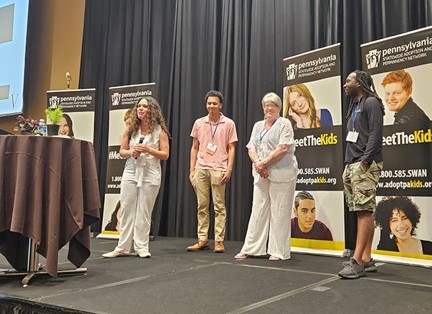
SSW keynote presenter Valerie Frost leads three audience members through an exercise to demonstrate differences among individual children and youth.
How do we move beyond inviting youth to the table and ensure their voices genuinely shape the decisions that affect their lives?
That question framed the opening keynote of the SWAN Summer Statewide Meeting, where permanency professionals from across Pennsylvania gathered to connect with one another and learn, including exploring practical strategies for strengthening youth engagement, belonging and lifelong connections.
Opening remarks from the Office of Children, Youth and Families (OCYF), the SWAN prime contractor and the Independent Living Program highlighted Pennsylvania's continued investment in prevention, kinship care and cross-system collaboration. The network collectively celebrated more than 60,500 adoptions since SWAN's inception, including 1,710 finalized during the most recent federal fiscal year. The achievement reflects decades of work by county agencies, private providers, resource families and countless professionals committed to helping children achieve safe, stable and lasting permanency.
The keynote that followed challenged attendees to think differently about one of the profession's most familiar concepts: youth engagement.
National speaker, educator and systems advocate Valerie Frost drew on both lived experience and years of work alongside child welfare systems to demonstrate how concepts such as “youth voice” and “trauma-informed practice” become meaningful only when they influence everyday interactions and decisions. Rather than offering theory alone, she provided practical tools professionals can use in case planning, permanency conversations and relationship-building with youth.
One of Valerie’s most memorable illustrations compared young people to three plants, each of which thrives under different conditions. A care plan that works perfectly for one plant may harm another. Likewise, for children and youth, standardized approaches may be efficient, but they rarely recognize the unique strengths, experiences and conditions that shape each young person's journey. Instead of asking, 'What's wrong with this youth?' Valerie encouraged participants to ask, 'What conditions surround this youth?'
Valerie also challenged the audience members to reconsider how their agencies define engagement. Youth attendance at meetings, advisory boards or permanency planning sessions is often treated as success. Yet being present is not the same as having influence. She described engagement as a spectrum that begins with informing youth and progresses through consultation and collaboration to shared leadership. The goal, she said, is not simply to invite young people into conversations but to create opportunities for them to shape the decisions that affect their lives.
That shift requires more than good intentions. Valerie emphasized that ethical engagement depends on creating conditions where youth can safely share their perspectives and know their voices matter. She identified five interconnected elements that support meaningful engagement: protection, power, accountability, boundaries and ownership. Together, these elements help ensure young people understand what decisions are being made, what influence they have, how their input will be used and what happens next.
Valerie emphasized that meaningful engagement is built through trust, clarity, reciprocity and follow-through. Permanency is ultimately about relationships and belonging, not simply placements, services or completed paperwork.
Valerie concluded her presentation with four reflective questions for permanency workers to carry into their practice:
- Who prepares youth?
- Who explains decisions?
- Who closes the loop?
- Who helps build connections?
These questions serve as a reminder that every interaction is an opportunity to strengthen trust, increase belonging and help young people experience the lasting relationships that define true permanency.